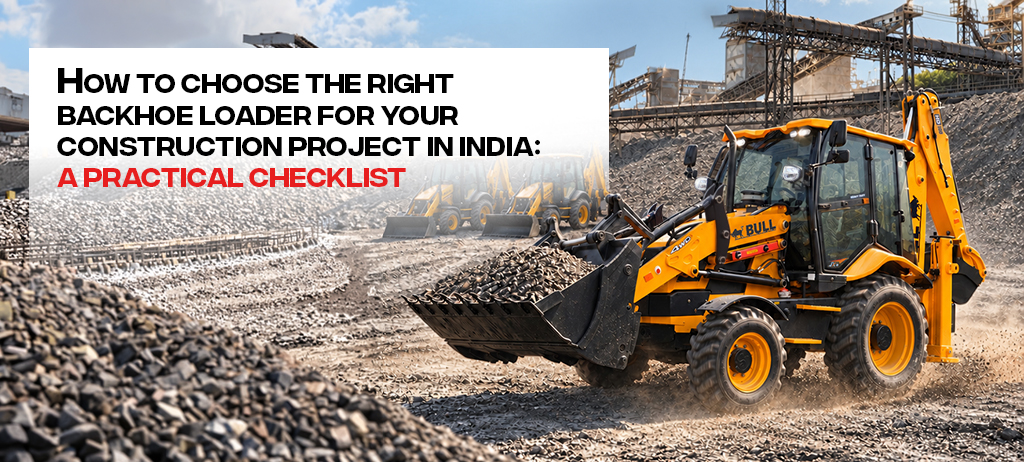
How to Choose the Right Backhoe Loader for Your Construction Project in India: A Practical Checklist
November 27,2026
Buying a backhoe loader isn’t like buying a car. There’s no “test drive it for a weekend and return it if you don’t like it.” Once that machine rolls onto your site, you’re committed – to the fuel bill, the EMI, the service costs, and the productivity (or lack of it) for the next 8-10 years.
And yet, a surprising number of contractors in India still choose their backhoe loader the way they’d choose a phone: based on brand recall, a friend’s recommendation, or whichever dealer called first. That’s a risky way to spend anywhere between ₹25 lakh and ₹40 lakh.
Backhoe loaders aren’t a small category either. They’re the single most-bought category of construction equipment in the country, doing double duty as a digger and a loader on everything from highway drainage work to farm ponds to demolition clearing. Which is exactly why picking the wrong one is so easy and so expensive.
So before you sign anything, run your decision through this checklist.
Start With the Job, Not the Brochure
The first mistake most first-time buyers make is falling in love with a machine before figuring out what they actually need it to do. A backhoe loader that’s brilliant for trenching utility lines in soft urban soil might struggle on a rocky mining access road. One built for constant loading and material handling might be overkill for a contractor who only digs foundation pits twice a month.
Before you look at a single spec sheet, answer this: What will this machine do on 80% of its working days? Digging depth, trenching width, loading frequency, and terrain type should drive your shortlist not the other way around.
How Much Engine Power Do You Actually Need
Most backhoe loaders sold in India sit somewhere between 49 HP and 100 HP. It’s tempting to assume “more HP = better machine,” but that’s not quite right. A 49-76 HP machine is more than capable for general construction, road maintenance, and small-to-mid infrastructure jobs, and it sips less diesel while doing it. Step up to 96-100 HP only if you’re regularly dealing with harder ground, larger bucket loads, or longer duty cycles – think mining support work, quarry loading, or big earthmoving contracts.
Bull Machines’ HD 76 runs a 76 HP Kirloskar engine, which covers the bulk of general contracting work comfortably. The HD 96 steps up to a 96 HP Kirloskar unit for tougher jobs, and the HD 100 goes further still with a Perkins engine paired to a ZF power-shift transmission for continuous heavy-duty use. The point isn’t which number is biggest – it’s which one matches your actual workload without you paying (and burning fuel) for horsepower you’ll never use.
2WD or 4WD — Let the Terrain Decide
This one’s simpler than it seems. If your sites are mostly flat, paved, or firm urban ground, a 2WD backhoe loader will do the job at a lower purchase price and lower running cost. If you’re regularly working on loose soil, slopes, unpaved rural roads, or wet monsoon-season sites, 4WD earns its extra cost back in traction, stability, and fewer stuck-machine headaches.
Rule of thumb: if you’ve ever had to call in a second machine to tow yours out of mud, you needed 4WD.
Digging Depth, Reach, and Bucket Capacity
This is where a lot of buyers get surprised after delivery. A machine that “looks similar” to another on a dealer’s lot can have a meaningfully different digging depth, dump height, or bucket capacity — and that difference decides whether you finish a trenching job in one pass or three.
Match these numbers against your most common job, not your biggest one. If 90% of your work is 4-5 feet trenches, don’t overpay for a machine built to dig 14-15 feet deep. Conversely, if you regularly work on foundation pits or drainage lines that need real depth, don’t get stuck with a shallow-reach machine to save a lakh or two upfront.
Operating Weight and Stability
Heavier isn’t automatically better, but it isn’t automatically worse either. A heavier machine — say, in the 7,500-8,000 kg range — generally gives you more stability while digging or lifting, especially with a loaded bucket at full reach. Lighter machines can be easier to transport between sites and gentler on soft ground, but may need more caution when working at full extension. Think about how often the machine moves between sites versus how much heavy lifting it does once it’s there, and weigh (literally) accordingly.
Fuel Consumption — The Cost You’ll Feel Every Single Day
The purchase price is a one-time conversation. Fuel is a daily one. A backhoe loader working a full shift can burn anywhere from 6 to 10+ litres of diesel per hour depending on engine size, load, and how efficiently the hydraulics are tuned. Over a 5-year ownership period, that difference adds up to lakhs of rupees — often more than the price gap between two competing models.
Ask any dealer for real fuel-consumption figures under load, not just the number printed in the brochure under ideal test conditions. And if you can, talk to an existing owner of that exact model. Ten minutes on the phone with someone who already owns the machine will tell you more than any spec sheet.
Hydraulics and Attachment Flexibility
A backhoe loader that only digs and loads is leaving money on the table. The real value-for-money machines let you swap in a breaker, auger, fork, grabber, or specialty bucket depending on the job. If your business takes on varied contracts — one month it’s trenching, the next it’s demolition debris clearing — a machine with strong hydraulic flow and a wide attachment range effectively becomes three or four machines in one.
Check the pump flow rate (measured in LPM) and working pressure (in bar/psi) before you buy. Higher numbers generally mean faster cycle times and the ability to run more demanding attachments.
After-Sales Support and Resale Value
Here’s the uncomfortable truth nobody puts on the brochure: the “best” machine on paper is worthless if there’s no service technician within 200 km of your site. Before buying, find out — realistically — how far the nearest service centre and spare parts stock point is, and how quickly a breakdown gets attended to. A machine parked idle for a week waiting on a part is costing you money whether it’s digging or not.
Resale value matters too, especially if you plan to upgrade your fleet in 4-5 years. Machines with a strong dealer network and a track record of reliability tend to hold their value far better than lesser-known imports, even if the upfront price looks attractive.
Operator Comfort Isn’t a Luxury Line Item
An operator who’s cramped, overheated, or straining to see the bucket edge all day isn’t working at full capacity — and tired operators make expensive mistakes. Look for a comfortable, ROPS/FOPS-compliant cabin, good visibility through curved glass, an adjustable seat, and controls that don’t require gymnastics to reach. It sounds like a soft factor until you calculate how much productivity you lose over a year to operator fatigue.
Look at Total Cost of Ownership, Not Just the Price Tag
Two backhoe loaders priced a lakh apart can end up costing wildly different amounts once you factor in fuel burn, service intervals, spare parts pricing, and resale value over five years. Before signing, do the maths on:
– Purchase price and financing cost (EMI, interest rate, down payment)
– Estimated fuel cost per month based on your working hours
– Scheduled service costs and typical spare parts availability
– Expected resale value at the point you’d likely upgrade
The machine with the lower EMI isn’t always the cheaper machine over its working life.
Your Quick Pre-Purchase Checklist
Before you finalise anything, run through this one last time:
– Have I matched engine HP to my typical (not occasional) workload?
– Do I need 2WD or 4WD based on my actual site conditions?
– Does the digging depth and bucket capacity fit my most common jobs?
– Have I checked real-world fuel consumption, not just brochure figures?
– Can this machine run the attachments my business actually needs?
– Is there a service centre and spare parts stock within a reasonable distance?
– Have I calculated the total cost of ownership, not just the on-road price?
– Have I sat in the cabin and checked comfort and visibility myself?
The Machine You Choose Is a Business Decision, Not a Purchase
A backhoe loader isn’t equipment — it’s a coworker that shows up every day, and its performance directly shapes how much work you can take on, how fast you finish it, and how much you keep as profit. Rushing that decision to save a week of research can cost you years of higher running costs and lower uptime.
Bull Machines builds its HD 76, HD 96, and HD 100 backhoe loaders around exactly this kind of real-world thinking — engine options sized for different workloads, drivetrain choices for different terrains, and a hydraulic system built to run a genuine range of attachments, backed by a dealer and service network across India. Whichever machine you eventually choose, make sure it’s chosen for the job in front of you — not just the one in the brochure.
Recent Posts